Stefan Knapp
1921 – 1996
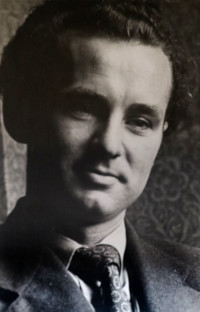 Stefan Knapp was a major figure in post-war art in Britain and Poland.
Born in Biłgoraj, Poland, in 1921 he was imprisoned in Siberia at the outbreak of World War II. Released in 1942 after the Sikorski-Maysk agreement, Knapp found his way to Britain and served as a Spitfire pilot in the RAF. After the War he settled in London, studying at the Slade, Central School of Art and the Royal Academy. Knapp would go on to write about his experiences in the war in his autobiography, The Square Sun.
A sculptor, painter, and inventor Knapp developed an international profile exhibiting at the Hannover and Pierre Matisse galleries, and museums across the world, attracting major commissions at the Seagram building and London Airport (Heathrow), amongst others. He is best known for developing a technique of applying enamel on steel to create work of architectural proportions.
Stefan Knapp was a major figure in post-war art in Britain and Poland.
Born in Biłgoraj, Poland, in 1921 he was imprisoned in Siberia at the outbreak of World War II. Released in 1942 after the Sikorski-Maysk agreement, Knapp found his way to Britain and served as a Spitfire pilot in the RAF. After the War he settled in London, studying at the Slade, Central School of Art and the Royal Academy. Knapp would go on to write about his experiences in the war in his autobiography, The Square Sun.
A sculptor, painter, and inventor Knapp developed an international profile exhibiting at the Hannover and Pierre Matisse galleries, and museums across the world, attracting major commissions at the Seagram building and London Airport (Heathrow), amongst others. He is best known for developing a technique of applying enamel on steel to create work of architectural proportions.
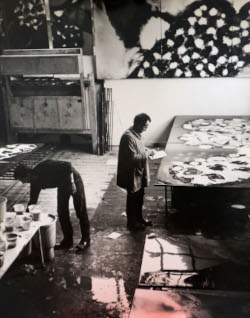 Alongside public murals, including on the Warsaw metro, St Anne's college Oxford, and Torun University, Knapp's work can be found in a number of prestigious institutional collections, including: Museum of Fine Art, Dallas; Museum of Modern Art, New York; The Tate Gallery, London; Museum of Fine Arts, Boston; Hall of Fame Museum, Mexico City; Breda Museum; Katowice Museum, Poland; Royal Palace, Rabat; The Art Center, Milwaukee; San Jose Museum of Arts, U.S.A.; Holocaust Museum, Melbourne; Neue Gallerie De Stadt, Linz; Stedelijk Museum, Amsterdam; Victoria & Albert Museum, London; Vatican Museum, Rome; Museo Nacional de Bellas Artes, Buenos Aires.
Major public commissions: C.I.N. Building, Paris; Synagogue, Ontario, Canada; Columbia University, New York; Lod Airport, Israel; Freiburg University; Alexander’s Valley Stream, USA; Safa Park, Dubai; Mondrian Hotel, Hollywood; Heathrow, London; University of Brunswick, Canada; Queens College, New York; Seagram Building, New York; Shell Building, London; St Anne’s College, Oxford.
Alongside public murals, including on the Warsaw metro, St Anne's college Oxford, and Torun University, Knapp's work can be found in a number of prestigious institutional collections, including: Museum of Fine Art, Dallas; Museum of Modern Art, New York; The Tate Gallery, London; Museum of Fine Arts, Boston; Hall of Fame Museum, Mexico City; Breda Museum; Katowice Museum, Poland; Royal Palace, Rabat; The Art Center, Milwaukee; San Jose Museum of Arts, U.S.A.; Holocaust Museum, Melbourne; Neue Gallerie De Stadt, Linz; Stedelijk Museum, Amsterdam; Victoria & Albert Museum, London; Vatican Museum, Rome; Museo Nacional de Bellas Artes, Buenos Aires.
Major public commissions: C.I.N. Building, Paris; Synagogue, Ontario, Canada; Columbia University, New York; Lod Airport, Israel; Freiburg University; Alexander’s Valley Stream, USA; Safa Park, Dubai; Mondrian Hotel, Hollywood; Heathrow, London; University of Brunswick, Canada; Queens College, New York; Seagram Building, New York; Shell Building, London; St Anne’s College, Oxford.